
Access Denied
IMPORTANT! If you’re a store owner, please make sure you have Customer accounts enabled in your Store Admin, as you have customer based locks set up with EasyLockdown app. Enable Customer Accounts
How-To: Embroider on Dark Fabrics Part 1


How do you get a design onto dark fabric? This is one of the most often-asked embroidery questions. Getting a design on dark fabric poses challenges. I'm going to show you what I think are the two easiest methods. This is the first one!
Supplies Needed:
- White Carbon transfer paper
- Tracing stylus (or ball-point pen)
- Something dark in plain cotton you want to stitch
-but not jeans, knits or a t-shirt (that's next tutorial)
The usual necessary tools for embroidery:
Let's get started...
Step 1: Here's a black, cotton shirt:

Step 2: You will need this carbon transfer paper:
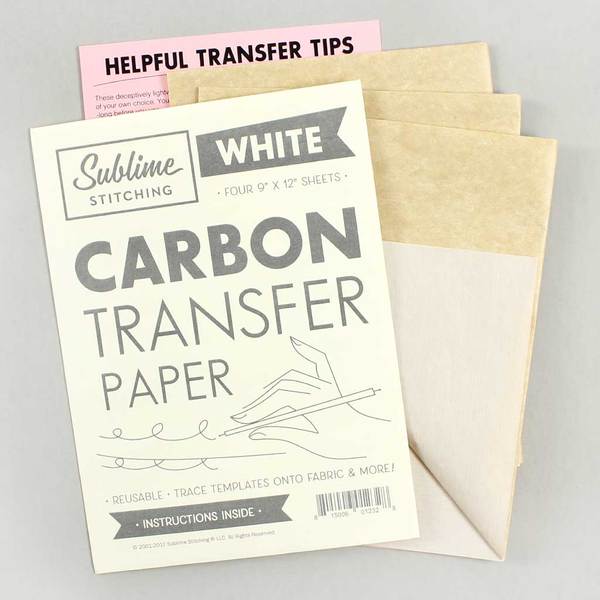
There are multiple kinds of transfer papers for transferring designs to fabric, and you should try them out to see what you like best. Personally, I never liked the chalky blue stuff (aka "dressmaker's carbon"). I find that it gets onto my fabric where I don't want it, and the lines are too faint and rub off before I can finish stitching up my design. My carbon transfer papers come in either dark gray (easy to see, won't rub off) or white. You can use these sheets again and again and again before you'll need more.
Step 3: When you take the paper out, be sure to separate them (they are superthin):

The lighter side of the sheet is the transferable side that will go against your fabric. (It's the opposite for the gray sheets: the darker side goes against your fabric.)
Step 4: Pick a design to trace and position it where you want it to appear:

Pattern: from Vital Organs
Place the carbon paper with the whiter side down to the fabric. Now place your pattern on top.
HINT: If you want to tape or pin your pattern to the fabric, do it in this step. I'm just going to be really careful and hold the pattern in place with my fingers.
Step 5: Work against a hard, smooth surface:

(Because I'm stitching on a shirt, instead of just a single-layer of fabric, I'm going to stick a hard-cover book inside so that I have a nice, smooth surface to trace against.)
IMPORTANT: When you are tracing a design with the carbon transfer papers, it's extra important that you have a smooth, hard surface underneath your fabric to trace against. If the surface is too soft, uneven or spongey, your pen or stylus will may tear through the carbon transfer paper, or the design won't appear. (I show you how to deal with soft, spongey fabrics in this tutorial.)
Step 6: Trace!

TIPS ON TRACING:
- Tape (or pin) the pattern in place to your fabric, but not the carbon transfer paper. The carbon paper is so thin, it will just tear when you try to remove the tape and you'll be bummed. It's fine if the carbon paper shifts when tracing, but not your pattern. Tape the pattern where you want it, and slip the carbon transfer paper underneath it.
- If you're not using a tracing stylus (these are handy when you don't want to mark with an ink pen over the design you're tracing), I advise using a pen of a different color than your pattern so you can see where you have and haven't traced.
- Be careful not to get ink stains on your fabric from the side of your hand! I speak from experience. This is why a stylus is a pro move.
Step 7: Check the results!

Can you believe it? It's a clearly visible pattern in white!
It won't rub off, and you won't be squinting, trying to figure out where the lines of your pattern are! Let's move on to the best part...
Step 8: EMBROIDER IT.


See? That wasn't so hard. Still have questions?
What about white transfer pens? They used to exist -but produced very mixed results. Currently, no white transfer pens are available.
Wait! What about stitching on dark jeans, knits or dark t-shirts?
Check out Part 2 of White Patterns on Dark Fabrics!
x - x - x - x - x - x
Text, photos and instructions by Jenny Hart ♥ © 2011 - 2022 Sublime Stitching®. No part of this tutorial may be reproduced in whole or in part without written permission from its author. Man, I hate having to say that.
First Published 03/03/11
Invalid password
Enter


