$node = stdClass Object (
[nid] => [3791]
[vid] => [3792]
[type] => [page]
[status] => [1]
[created] => [1249662719]
[changed] => [1282844274]
[comment] => [2]
[promote] => [0]
[sticky] => [0]
[revision_timestamp] => [1282844274]
[title] => [How To: Satin Stitch]
[body] => [<div style="text-align: center">
<img src="/files/images/satinstitch_logo.gif" border="0" height="88" width="352" />by Jenny Hart
</div>
<br />
<p align="center">
Did I hear somone say "how do you make a satin stitch"? Or, "how do I
solidly fill in an area"? Was that you? Well, you *can* use any stitch
you want to fill an area in solidly, but the satin stitch is one of the
quickest ways. Here are three methods: <b>plain, outlined</b> and <b>inline (or padded</b>). There's also a little <i>no-pattern-necessary</i> design at the end!
</p>
<h3 align="center">
<b>
</b></h3>
<p align="center">
<img src="/files/images/satin_1.jpg" height="384" width="512" />
</p>
<p align="center">
Let's say you have a shape you want to fill in. I dunno, like, oh say...a circle.
</p>
<p align="center">
</p>
<p align="center">
<img src="/files/images/satin_2.jpg" height="384" width="512" />
</p>
<p align="center">
<b>Step 1: <br />
</b>Bring your needle up along the outer edge of the shape and reinsert your needle across from it, on the other side. Note: I started in the middle of the circle because I think it's easier than trying to begin with the smallest stitches at the ends. We'll work toward those.
</p>
<p align="center">
</p>
<p align="center">
<img src="/files/images/satin3.jpg" height="384" width="512" />
</p>
<p align="center">
<b>Step 2:</b> <br />
Pull your needle all the way through, making a long stitch from one side to the other. Okay now, pay attention because the next step is important!
</p>
<p align="center">
</p>
<p align="center">
<img src="/files/images/satinwild.jpg" height="384" width="512" />
</p>
<p align="center">
<b>Step 3:</b><br />
Bring your needle up again back at the place where you started,<i> not</i> next to where you pulled you last stitch through. <br />
It will be too hard to make the stitches right next to each other if you do, with only a few fibers of fabric in-between, <br />
causing you unnecessary aggravation. We don't want that.
</p>
<p align="center">
</p>
<p align="center">
<img src="/files/images/satin4.jpg" height="384" width="512" />
</p>
<p align="center">
<b>Step 4:</b><br />
See? Like so. You are doing splendidly!
</p>
<p align="center">
</p>
<p align="center">
<img src="/files/images/satin5.jpg" height="384" width="512" />
</p>
<p align="center">
<b>Step 5:</b><br />
Repeat, repeat, repeat.<br />
</p>
<p align="left">
<i>Disclaimer! </i>Experienced needleworkers will often
"strip" their floss before they work a satin stitch. "Stripping" is
when you run stranded embroidery floss across a bit of velcro, evening
out all the strands. This will often make your stitching neater and
easier. And, when working a satin stitch, it helps to hide the stitches
so it looks like one solid area. A knowledgeable needleworker will see
that I didn't bother to strip my floss! I'm an un-fussy stitcher.
That's just me. But, if you'd like a little more finesse to your satin
stitch, strip it!
</p>
<p align="center">
</p>
<p align="center">
<img src="/files/images/satin6.jpg" height="384" width="512" />
</p>
<p align="center">
Take a peek at the back. It should look the same as the front.
</p>
<p align="center">
</p>
<p align="center">
<img src="/files/images/satin6_2.jpg" height="384" width="512" />
</p>
<p align="center">
<b>Step 6:</b>
</p>
<p align="center">
All finished! Nice. Kinda looks like a cough drop. You can tell now that I didn't strip my floss first, <br />
because you can see, more or less, each stitch I've made. Oh, I'm just not that bothered.
</p>
<p align="center">
The next question is usually <br />
"what if I want to outline it?" Well then let's talk about the...
</p>
<p align="center">
</p>
<h3 align="center"><b>Outlined Satin Stitch </b><br />
</h3>
<p align="center">
<img src="/files/images/satin6_3.jpg" height="384" width="512" />
</p>
<p align="center">
So outline it already! You can use whatever you stitch you want. I am outlinining it here <br />
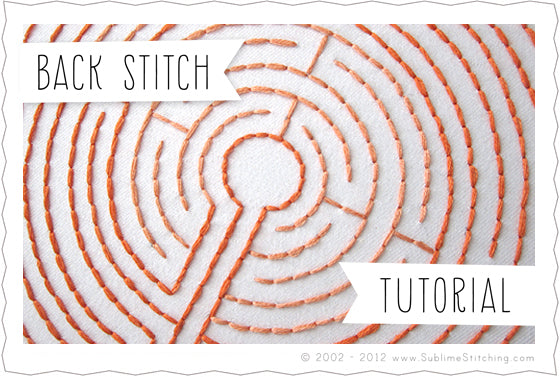
in a <a href="/stitches#Back%20Stitch" target="_blank">back stitch</a> and got all wild 'n crazy and with a new color.
</p>
<p align="center">
</p>
<p align="center">
<img src="/files/images/satin7.jpg" height="384" width="512" />
</p>
<p align="center">
Minou is <i>thrilled</i> by my outlined satin stitch.
</p>
<p align="center">
I will now close my eyes, concentrate reeeally hard and predict your next question. Silence please. (Holding temples) You want to know: "so, should I outline it first or after?". Am I right? If you are outlining, it is much easier to do it <i>after</i>. Otherwise, your needle will always be catching or snagging on the stitches you made while you try to satin up the center. But, here's what you can do with a pre-outlined shape:
</p>
<h3 align="center"> </h3>
<h3 align="center">Inlined (or Padded) Satin Stitch </h3>
<p align="center">
<img src="/files/images/satin8.jpg" height="384" width="512" />
</p>
<p align="center">
I outlined the shape first this time (that's a <a href="/stitches#Split%20Stitch" target="_blank">split stitch</a>). Now check out this smooth move:
</p>
<p align="center">
</p>
<p align="center">
<img src="/files/images/satin9.jpg" height="384" width="512" />
</p>
<p align="center">
I am going to work my satin stitch just as I did before, but I will bring my needle up <i>outside</i> the stitched I worked.
</p>
<p align="center">
You can also "seed" the inside of the circle with random, straight stitches which is called a <b>padded</b> satin stitch.
</p>
<p align="center">
</p>
<p align="center">
<img src="/files/images/satin10.jpg" height="384" width="512" />
</p>
<p align="center">
Like so! Keep working your stitches like this since you're already a newly-minted expert in the satin stitch. The results are:
</p>
<p align="center">
</p>
<p align="center">
<img src="/files/images/satin11.jpg" height="384" width="512" />
</p>
<p align="center">
A nice, thicker, more outstanding (and upstanding) bit of stitching! Lesson over? Not yet! I had me an ideer.
</p>
<p align="center">
</p>
<p align="center">
<img src="/files/images/satin12.jpg" height="384" width="512" />
</p>
<p align="center">
Get out the pencil. Draw some lines. That was tough.
</p>
<p align="center">
</p>
<p align="center">
<img src="/files/images/satin13.jpg" height="384" width="512" />
</p>
<p align="center">
Let's try a <a href="/stitches#Stem%20Stitch" target="_blank">stem stitch</a> in green there. See how not perfect my stitches are? <br />
It's okay if yours aren't either. Enjoyment is to be valued over perfection.
</p>
<p align="center">
</p>
<p align="center">
<img src="/files/images/satin14.jpg" height="384" width="512" />
</p>
<p align="center">
"Gosh, I wonder where she's going with this?"
</p>
<p align="center">
</p>
<p align="center">
<img src="/files/images/satin15.jpg" height="384" width="512" />
</p>
<p align="center">
Pattern? I don't need no stinking pattern! I'm just going to add some downward-pointing, <a href="/lazylotus.html">isolated chain stitches</a> <br />
(which you learned in my <a href="/lazylotus.html" target="_blank">Lazy Lotus tute</a>) for tiny leaves...
</p>
<p align="center">
</p>
<p align="center">
<img src="/files/images/satin16.jpg" height="384" width="512" />
</p>
<p align="center">
Oooh! Ooh! I know! Some <a href="/frenchknot.html" target="_blank">French knots</a> around like this...
</p>
<p align="center">
</p>
<p align="center">
<img src="/files/images/satin17.jpg" height="384" width="512" />
</p>
<p align="center">
Aaand howsabout putting some single stitches in the middle of that other one like this...
</p>
<p align="center">
</p>
<p align="center">
<img src="/files/images/satin18.jpg" height="512" width="384" />
</p>
<p align="center">
Kerblam. Cute. Easy. Took me a whole 15 minutes.
</p>
<p align="center">
</p>
<p align="center">
<img src="/files/images/satin19.jpg" height="384" width="512" />
</p>
<p align="center">
Or, long enough for Minou to go right back to sleep.
</p>
<p align="center">
</p>
<p align="center">
<b>You like?</b> Well, then you'll be glad to know that I have a brand-new book coming out very soon full of techniques and ideas like this, including transfer patterns and projects for satin stitching and a whole bunch more:
</p>
<div align="center">
<img src="/files/images/embroideredeffects_cover_0.jpg" height="394" width="432" />
</div>
<div align="center">
<h3><a href="/pre-order%20now" target="_blank"><i>Embroidered Effects </i>by Jenny Hart </a><br />
(Chronicle Books)</h3>
<p>
</p>
<p>
</p>
<p>
Text, photos and instructions by Jenny Hart ©2009 - 2010 Sublime Stitching®. No part of this tutorial may be reproduced in whole or in part without written permission from its author. Man, I hate having to say that.
</p>
</div>
<div align="center">
<br />
</div>
]
[teaser] => [ <div style="text-align: center">
<img src="/files/images/satinstitch_logo.gif" border="0" height="88" width="352" />by Jenny Hart
</div>
<br />
<p align="center">
Did I hear somone say "how do you make a satin stitch"? Or, "how do I
solidly fill in an area"? Was that you? Well, you *can* use any stitch
you want to fill an area in solidly, but the satin stitch is one of the
quickest ways. Here are three methods: <b>plain, outlined</b> and <b>inline (or padded</b>). There's also a little <i>no-pattern-necessary</i> design at the end!
</p>
<h3 align="center">
<b>
</b></h3>
<p align="center">
<img src="/files/images/satin_1.jpg" height="384" width="512" />
</p>
<p align="center">
Let's say you have a shape you want to fill in. I dunno, like, oh say...a circle.
</p>
<p align="center">
</p>
<p align="center">
<img src="/files/images/satin_2.jpg" height="384" width="512" />
</p>
<p align="center">
<b>Step 1: <br />
</b>Bring your needle up along the outer edge of the shape and reinsert your needle across from it, on the other side. Note: I started in the middle of the circle because I think it's easier than trying to begin with the smallest stitches at the ends. We'll work toward those.
</p>
<p align="center">
</p>
<p align="center">
<img src="/files/images/satin3.jpg" height="384" width="512" />
</p>
<p align="center">
<b>Step 2:</b> <br />
Pull your needle all the way through, making a long stitch from one side to the other. Okay now, pay attention because the next step is important!
</p>
<p align="center">
</p>
<p align="center">
<img src="/files/images/satinwild.jpg" height="384" width="512" />
</p>
<p align="center">
<b>Step 3:</b><br />
Bring your needle up again back at the place where you started,<i> not</i> next to where you pulled you last stitch through. <br />
It will be too hard to make the stitches right next to each other if you do, with only a few fibers of fabric in-between, <br />
causing you unnecessary aggravation. We don't want that.
</p>
<p align="center">
</p>
<p align="center">
<img src="/files/images/satin4.jpg" height="384" width="512" />
</p>
<p align="center">
<b>Step 4:</b><br />
See? Like so. You are doing splendidly!
</p>
<p align="center">
</p>
<p align="center">
<img src="/files/images/satin5.jpg" height="384" width="512" />
</p>
<p align="center">
<b>Step 5:</b><br />
Repeat, repeat, repeat.<br />
</p>
<p align="left">
<i>Disclaimer! </i>Experienced needleworkers will often
"strip" their floss before they work a satin stitch. "Stripping" is
when you run stranded <a class="glossary-term" href="/glossary/term/80"><abbr title="Embroidery can be so, so many things. This is the alpha term for most of the decorative needlearts. ‘Embroidery’ just means any kind of decorative stitching, which can include an endless variety of styles. If you make decorative stitches on fabric, you’re embroidering. You can work in any media on any surface in a free-form manner, along a pattern, or simply by repeating a stitch along a hem or cuff, or edge of a tablecloth. There are endless combinations of stitches and possibilities. Sublime Stitching patterns are designed for embroidery but can be used as templates for other kinds of embroidery as well. Other types of embroidery make use of specific tools and materials, and then earn new and unique names. ">embroidery</abbr></a> floss across a bit of velcro, evening
out all the strands. This will often make your stitching neater and
easier. And, when working a satin stitch, it helps to hide the stitches
so it looks like one solid area. A knowledgeable needleworker will see
that I didn't bother to strip my floss! I'm an un-fussy stitcher.
That's just me. But, if you'd like a little more finesse to your satin
stitch, strip it!
</p>
<p align="center">
</p>
<p align="center">
<img src="/files/images/satin6.jpg" height="384" width="512" />
</p>
<p align="center">
Take a peek at the back. It should look the same as the front.
</p>
<p align="center">
</p>
<p align="center">
<img src="/files/images/satin6_2.jpg" height="384" width="512" />
</p>
<p align="center">
<b>Step 6:</b>
</p>
<p align="center">
All finished! Nice. Kinda looks like a cough drop. You can tell now that I didn't strip my floss first, <br />
because you can see, more or less, each stitch I've made. Oh, I'm just not that bothered.
</p>
<p align="center">
The next question is usually <br />
"what if I want to outline it?" Well then let's talk about the...
</p>
<p align="center">
</p>
<h3 align="center"><b>Outlined Satin Stitch </b><br />
</h3>
<p align="center">
<img src="/files/images/satin6_3.jpg" height="384" width="512" />
</p>
<p align="center">
So outline it already! You can use whatever you stitch you want. I am outlinining it here <br />
in a <a href="/stitches#Back%20Stitch" target="_blank">back stitch</a> and got all wild 'n crazy and with a new color.
</p>
<p align="center">
</p>
<p align="center">
<img src="/files/images/satin7.jpg" height="384" width="512" />
</p>
<p align="center">
Minou is <i>thrilled</i> by my outlined satin stitch.
</p>
<p align="center">
I will now close my eyes, concentrate reeeally hard and predict your next question. Silence please. (Holding temples) You want to know: "so, should I outline it first or after?". Am I right? If you are outlining, it is much easier to do it <i>after</i>. Otherwise, your needle will always be catching or snagging on the stitches you made while you try to satin up the center. But, here's what you can do with a pre-outlined shape:
</p>
<h3 align="center"> </h3>
<h3 align="center">Inlined (or Padded) Satin Stitch </h3>
<p align="center">
<img src="/files/images/satin8.jpg" height="384" width="512" />
</p>
<p align="center">
I outlined the shape first this time (that's a <a href="/stitches#Split%20Stitch" target="_blank">split stitch</a>). Now check out this smooth move:
</p>
<p align="center">
</p>
<p align="center">
<img src="/files/images/satin9.jpg" height="384" width="512" />
</p>
<p align="center">
I am going to work my satin stitch just as I did before, but I will bring my needle up <i>outside</i> the stitched I worked.
</p>
<p align="center">
You can also "seed" the inside of the circle with random, straight stitches which is called a <b>padded</b> satin stitch.
</p>
<p align="center">
</p>
<p align="center">
<img src="/files/images/satin10.jpg" height="384" width="512" />
</p>
<p align="center">
Like so! Keep working your stitches like this since you're already a newly-minted expert in the satin stitch. The results are:
</p>
<p align="center">
</p>
<p align="center">
<img src="/files/images/satin11.jpg" height="384" width="512" />
</p>
<p align="center">
A nice, thicker, more outstanding (and upstanding) bit of stitching! Lesson over? Not yet! I had me an ideer.
</p>
<p align="center">
</p>
<p align="center">
<img src="/files/images/satin12.jpg" height="384" width="512" />
</p>
<p align="center">
Get out the pencil. Draw some lines. That was tough.
</p>
<p align="center">
</p>
<p align="center">
<img src="/files/images/satin13.jpg" height="384" width="512" />
</p>
<p align="center">
Let's try a <a href="/stitches#Stem%20Stitch" target="_blank">stem stitch</a> in green there. See how not perfect my stitches are? <br />
It's okay if yours aren't either. Enjoyment is to be valued over perfection.
</p>
<p align="center">
</p>
<p align="center">
<img src="/files/images/satin14.jpg" height="384" width="512" />
</p>
<p align="center">
"Gosh, I wonder where she's going with this?"
</p>
<p align="center">
</p>
<p align="center">
<img src="/files/images/satin15.jpg" height="384" width="512" />
</p>
<p align="center">
Pattern? I don't need no stinking pattern! I'm just going to add some downward-pointing, <a href="/lazylotus.html">isolated chain stitches</a> <br />
(which you learned in my <a href="/lazylotus.html" target="_blank">Lazy Lotus tute</a>) for tiny leaves...
</p>
<p align="center">
</p>
<p align="center">
<img src="/files/images/satin16.jpg" height="384" width="512" />
</p>
<p align="center">
Oooh! Ooh! I know! Some <a href="/frenchknot.html" target="_blank">French knots</a> around like this...
</p>
<p align="center">
</p>
<p align="center">
<img src="/files/images/satin17.jpg" height="384" width="512" />
</p>
<p align="center">
Aaand howsabout putting some single stitches in the middle of that other one like this...
</p>
<p align="center">
</p>
<p align="center">
<img src="/files/images/satin18.jpg" height="512" width="384" />
</p>
<p align="center">
Kerblam. Cute. Easy. Took me a whole 15 minutes.
</p>
<p align="center">
</p>
<p align="center">
<img src="/files/images/satin19.jpg" height="384" width="512" />
</p>
<p align="center">
Or, long enough for Minou to go right back to sleep.
</p>
<p align="center">
</p>
<p align="center">
<b>You like?</b> Well, then you'll be glad to know that I have a brand-new book coming out very soon full of techniques and ideas like this, including transfer patterns and projects for satin stitching and a whole bunch more:
</p>
<div align="center">
<img src="/files/images/embroideredeffects_cover_0.jpg" height="394" width="432" />
</div>
<div align="center">
<h3><a href="/pre-order%20now" target="_blank"><i>Embroidered Effects </i>by Jenny Hart </a><br />
(Chronicle Books)</h3>
<p>
</p>
<p>
</p>
<p>
Text, photos and instructions by Jenny Hart ©2009 - 2010 Sublime Stitching®. No part of this tutorial may be reproduced in whole or in part without written permission from its author. Man, I hate having to say that.
</p>
</div>
<div align="center">
<br />
</div>
]
[log] => []
[format] => [4]
[uid] => [2]
[name] => [Jenny ♥]
[picture] => []
[data] => [a:2:{s:7:"contact";i:1;s:29:"taxonomy_image_disable_images";i:0;}]
[search_block] => []
[nodewords] => []
[last_comment_timestamp] => [1249662719]
[last_comment_name] => []
[comment_count] => [0]
[taxonomy] => []
[files] => []
[readmore] => []
[content] => array (
[body] => array (
[#weight] => [0]
[#value] => [ <div style="text-align: center">
<img src="/files/images/satinstitch_logo.gif" border="0" height="88" width="352" />by Jenny Hart
</div>
<br />
<p align="center">
Did I hear somone say "how do you make a satin stitch"? Or, "how do I
solidly fill in an area"? Was that you? Well, you *can* use any stitch
you want to fill an area in solidly, but the satin stitch is one of the
quickest ways. Here are three methods: <b>plain, outlined</b> and <b>inline (or padded</b>). There's also a little <i>no-pattern-necessary</i> design at the end!
</p>
<h3 align="center">
<b>
</b></h3>
<p align="center">
<img src="/files/images/satin_1.jpg" height="384" width="512" />
</p>
<p align="center">
Let's say you have a shape you want to fill in. I dunno, like, oh say...a circle.
</p>
<p align="center">
</p>
<p align="center">
<img src="/files/images/satin_2.jpg" height="384" width="512" />
</p>
<p align="center">
<b>Step 1: <br />
</b>Bring your needle up along the outer edge of the shape and reinsert your needle across from it, on the other side. Note: I started in the middle of the circle because I think it's easier than trying to begin with the smallest stitches at the ends. We'll work toward those.
</p>
<p align="center">
</p>
<p align="center">
<img src="/files/images/satin3.jpg" height="384" width="512" />
</p>
<p align="center">
<b>Step 2:</b> <br />
Pull your needle all the way through, making a long stitch from one side to the other. Okay now, pay attention because the next step is important!
</p>
<p align="center">
</p>
<p align="center">
<img src="/files/images/satinwild.jpg" height="384" width="512" />
</p>
<p align="center">
<b>Step 3:</b><br />
Bring your needle up again back at the place where you started,<i> not</i> next to where you pulled you last stitch through. <br />
It will be too hard to make the stitches right next to each other if you do, with only a few fibers of fabric in-between, <br />
causing you unnecessary aggravation. We don't want that.
</p>
<p align="center">
</p>
<p align="center">
<img src="/files/images/satin4.jpg" height="384" width="512" />
</p>
<p align="center">
<b>Step 4:</b><br />
See? Like so. You are doing splendidly!
</p>
<p align="center">
</p>
<p align="center">
<img src="/files/images/satin5.jpg" height="384" width="512" />
</p>
<p align="center">
<b>Step 5:</b><br />
Repeat, repeat, repeat.<br />
</p>
<p align="left">
<i>Disclaimer! </i>Experienced needleworkers will often
"strip" their floss before they work a satin stitch. "Stripping" is
when you run stranded <a class="glossary-term" href="/glossary/term/80"><abbr title="Embroidery can be so, so many things. This is the alpha term for most of the decorative needlearts. ‘Embroidery’ just means any kind of decorative stitching, which can include an endless variety of styles. If you make decorative stitches on fabric, you’re embroidering. You can work in any media on any surface in a free-form manner, along a pattern, or simply by repeating a stitch along a hem or cuff, or edge of a tablecloth. There are endless combinations of stitches and possibilities. Sublime Stitching patterns are designed for embroidery but can be used as templates for other kinds of embroidery as well. Other types of embroidery make use of specific tools and materials, and then earn new and unique names. ">embroidery</abbr></a> floss across a bit of velcro, evening
out all the strands. This will often make your stitching neater and
easier. And, when working a satin stitch, it helps to hide the stitches
so it looks like one solid area. A knowledgeable needleworker will see
that I didn't bother to strip my floss! I'm an un-fussy stitcher.
That's just me. But, if you'd like a little more finesse to your satin
stitch, strip it!
</p>
<p align="center">
</p>
<p align="center">
<img src="/files/images/satin6.jpg" height="384" width="512" />
</p>
<p align="center">
Take a peek at the back. It should look the same as the front.
</p>
<p align="center">
</p>
<p align="center">
<img src="/files/images/satin6_2.jpg" height="384" width="512" />
</p>
<p align="center">
<b>Step 6:</b>
</p>
<p align="center">
All finished! Nice. Kinda looks like a cough drop. You can tell now that I didn't strip my floss first, <br />
because you can see, more or less, each stitch I've made. Oh, I'm just not that bothered.
</p>
<p align="center">
The next question is usually <br />
"what if I want to outline it?" Well then let's talk about the...
</p>
<p align="center">
</p>
<h3 align="center"><b>Outlined Satin Stitch </b><br />
</h3>
<p align="center">
<img src="/files/images/satin6_3.jpg" height="384" width="512" />
</p>
<p align="center">
So outline it already! You can use whatever you stitch you want. I am outlinining it here <br />
in a <a href="/stitches#Back%20Stitch" target="_blank">back stitch</a> and got all wild 'n crazy and with a new color.
</p>
<p align="center">
</p>
<p align="center">
<img src="/files/images/satin7.jpg" height="384" width="512" />
</p>
<p align="center">
Minou is <i>thrilled</i> by my outlined satin stitch.
</p>
<p align="center">
I will now close my eyes, concentrate reeeally hard and predict your next question. Silence please. (Holding temples) You want to know: "so, should I outline it first or after?". Am I right? If you are outlining, it is much easier to do it <i>after</i>. Otherwise, your needle will always be catching or snagging on the stitches you made while you try to satin up the center. But, here's what you can do with a pre-outlined shape:
</p>
<h3 align="center"> </h3>
<h3 align="center">Inlined (or Padded) Satin Stitch </h3>
<p align="center">
<img src="/files/images/satin8.jpg" height="384" width="512" />
</p>
<p align="center">
I outlined the shape first this time (that's a <a href="/stitches#Split%20Stitch" target="_blank">split stitch</a>). Now check out this smooth move:
</p>
<p align="center">
</p>
<p align="center">
<img src="/files/images/satin9.jpg" height="384" width="512" />
</p>
<p align="center">
I am going to work my satin stitch just as I did before, but I will bring my needle up <i>outside</i> the stitched I worked.
</p>
<p align="center">
You can also "seed" the inside of the circle with random, straight stitches which is called a <b>padded</b> satin stitch.
</p>
<p align="center">
</p>
<p align="center">
<img src="/files/images/satin10.jpg" height="384" width="512" />
</p>
<p align="center">
Like so! Keep working your stitches like this since you're already a newly-minted expert in the satin stitch. The results are:
</p>
<p align="center">
</p>
<p align="center">
<img src="/files/images/satin11.jpg" height="384" width="512" />
</p>
<p align="center">
A nice, thicker, more outstanding (and upstanding) bit of stitching! Lesson over? Not yet! I had me an ideer.
</p>
<p align="center">
</p>
<p align="center">
<img src="/files/images/satin12.jpg" height="384" width="512" />
</p>
<p align="center">
Get out the pencil. Draw some lines. That was tough.
</p>
<p align="center">
</p>
<p align="center">
<img src="/files/images/satin13.jpg" height="384" width="512" />
</p>
<p align="center">
Let's try a <a href="/stitches#Stem%20Stitch" target="_blank">stem stitch</a> in green there. See how not perfect my stitches are? <br />
It's okay if yours aren't either. Enjoyment is to be valued over perfection.
</p>
<p align="center">
</p>
<p align="center">
<img src="/files/images/satin14.jpg" height="384" width="512" />
</p>
<p align="center">
"Gosh, I wonder where she's going with this?"
</p>
<p align="center">
</p>
<p align="center">
<img src="/files/images/satin15.jpg" height="384" width="512" />
</p>
<p align="center">
Pattern? I don't need no stinking pattern! I'm just going to add some downward-pointing, <a href="/lazylotus.html">isolated chain stitches</a> <br />
(which you learned in my <a href="/lazylotus.html" target="_blank">Lazy Lotus tute</a>) for tiny leaves...
</p>
<p align="center">
</p>
<p align="center">
<img src="/files/images/satin16.jpg" height="384" width="512" />
</p>
<p align="center">
Oooh! Ooh! I know! Some <a href="/frenchknot.html" target="_blank">French knots</a> around like this...
</p>
<p align="center">
</p>
<p align="center">
<img src="/files/images/satin17.jpg" height="384" width="512" />
</p>
<p align="center">
Aaand howsabout putting some single stitches in the middle of that other one like this...
</p>
<p align="center">
</p>
<p align="center">
<img src="/files/images/satin18.jpg" height="512" width="384" />
</p>
<p align="center">
Kerblam. Cute. Easy. Took me a whole 15 minutes.
</p>
<p align="center">
</p>
<p align="center">
<img src="/files/images/satin19.jpg" height="384" width="512" />
</p>
<p align="center">
Or, long enough for Minou to go right back to sleep.
</p>
<p align="center">
</p>
<p align="center">
<b>You like?</b> Well, then you'll be glad to know that I have a brand-new book coming out very soon full of techniques and ideas like this, including transfer patterns and projects for satin stitching and a whole bunch more:
</p>
<div align="center">
<img src="/files/images/embroideredeffects_cover_0.jpg" height="394" width="432" />
</div>
<div align="center">
<h3><a href="/pre-order%20now" target="_blank"><i>Embroidered Effects </i>by Jenny Hart </a><br />
(Chronicle Books)</h3>
<p>
</p>
<p>
</p>
<p>
Text, photos and instructions by Jenny Hart ©2009 - 2010 Sublime Stitching®. No part of this tutorial may be reproduced in whole or in part without written permission from its author. Man, I hate having to say that.
</p>
</div>
<div align="center">
<br />
</div>
]
[#printed] => [1]
)
[#children] => [ <div style="text-align: center">
<img src="/files/images/satinstitch_logo.gif" border="0" height="88" width="352" />by Jenny Hart
</div>
<br />
<p align="center">
Did I hear somone say "how do you make a satin stitch"? Or, "how do I
solidly fill in an area"? Was that you? Well, you *can* use any stitch
you want to fill an area in solidly, but the satin stitch is one of the
quickest ways. Here are three methods: <b>plain, outlined</b> and <b>inline (or padded</b>). There's also a little <i>no-pattern-necessary</i> design at the end!
</p>
<h3 align="center">
<b>
</b></h3>
<p align="center">
<img src="/files/images/satin_1.jpg" height="384" width="512" />
</p>
<p align="center">
Let's say you have a shape you want to fill in. I dunno, like, oh say...a circle.
</p>
<p align="center">
</p>
<p align="center">
<img src="/files/images/satin_2.jpg" height="384" width="512" />
</p>
<p align="center">
<b>Step 1: <br />
</b>Bring your needle up along the outer edge of the shape and reinsert your needle across from it, on the other side. Note: I started in the middle of the circle because I think it's easier than trying to begin with the smallest stitches at the ends. We'll work toward those.
</p>
<p align="center">
</p>
<p align="center">
<img src="/files/images/satin3.jpg" height="384" width="512" />
</p>
<p align="center">
<b>Step 2:</b> <br />
Pull your needle all the way through, making a long stitch from one side to the other. Okay now, pay attention because the next step is important!
</p>
<p align="center">
</p>
<p align="center">
<img src="/files/images/satinwild.jpg" height="384" width="512" />
</p>
<p align="center">
<b>Step 3:</b><br />
Bring your needle up again back at the place where you started,<i> not</i> next to where you pulled you last stitch through. <br />
It will be too hard to make the stitches right next to each other if you do, with only a few fibers of fabric in-between, <br />
causing you unnecessary aggravation. We don't want that.
</p>
<p align="center">
</p>
<p align="center">
<img src="/files/images/satin4.jpg" height="384" width="512" />
</p>
<p align="center">
<b>Step 4:</b><br />
See? Like so. You are doing splendidly!
</p>
<p align="center">
</p>
<p align="center">
<img src="/files/images/satin5.jpg" height="384" width="512" />
</p>
<p align="center">
<b>Step 5:</b><br />
Repeat, repeat, repeat.<br />
</p>
<p align="left">
<i>Disclaimer! </i>Experienced needleworkers will often
"strip" their floss before they work a satin stitch. "Stripping" is
when you run stranded <a class="glossary-term" href="/glossary/term/80"><abbr title="Embroidery can be so, so many things. This is the alpha term for most of the decorative needlearts. ‘Embroidery’ just means any kind of decorative stitching, which can include an endless variety of styles. If you make decorative stitches on fabric, you’re embroidering. You can work in any media on any surface in a free-form manner, along a pattern, or simply by repeating a stitch along a hem or cuff, or edge of a tablecloth. There are endless combinations of stitches and possibilities. Sublime Stitching patterns are designed for embroidery but can be used as templates for other kinds of embroidery as well. Other types of embroidery make use of specific tools and materials, and then earn new and unique names. ">embroidery</abbr></a> floss across a bit of velcro, evening
out all the strands. This will often make your stitching neater and
easier. And, when working a satin stitch, it helps to hide the stitches
so it looks like one solid area. A knowledgeable needleworker will see
that I didn't bother to strip my floss! I'm an un-fussy stitcher.
That's just me. But, if you'd like a little more finesse to your satin
stitch, strip it!
</p>
<p align="center">
</p>
<p align="center">
<img src="/files/images/satin6.jpg" height="384" width="512" />
</p>
<p align="center">
Take a peek at the back. It should look the same as the front.
</p>
<p align="center">
</p>
<p align="center">
<img src="/files/images/satin6_2.jpg" height="384" width="512" />
</p>
<p align="center">
<b>Step 6:</b>
</p>
<p align="center">
All finished! Nice. Kinda looks like a cough drop. You can tell now that I didn't strip my floss first, <br />
because you can see, more or less, each stitch I've made. Oh, I'm just not that bothered.
</p>
<p align="center">
The next question is usually <br />
"what if I want to outline it?" Well then let's talk about the...
</p>
<p align="center">
</p>
<h3 align="center"><b>Outlined Satin Stitch </b><br />
</h3>
<p align="center">
<img src="/files/images/satin6_3.jpg" height="384" width="512" />
</p>
<p align="center">
So outline it already! You can use whatever you stitch you want. I am outlinining it here <br />
in a <a href="/stitches#Back%20Stitch" target="_blank">back stitch</a> and got all wild 'n crazy and with a new color.
</p>
<p align="center">
</p>
<p align="center">
<img src="/files/images/satin7.jpg" height="384" width="512" />
</p>
<p align="center">
Minou is <i>thrilled</i> by my outlined satin stitch.
</p>
<p align="center">
I will now close my eyes, concentrate reeeally hard and predict your next question. Silence please. (Holding temples) You want to know: "so, should I outline it first or after?". Am I right? If you are outlining, it is much easier to do it <i>after</i>. Otherwise, your needle will always be catching or snagging on the stitches you made while you try to satin up the center. But, here's what you can do with a pre-outlined shape:
</p>
<h3 align="center"> </h3>
<h3 align="center">Inlined (or Padded) Satin Stitch </h3>
<p align="center">
<img src="/files/images/satin8.jpg" height="384" width="512" />
</p>
<p align="center">
I outlined the shape first this time (that's a <a href="/stitches#Split%20Stitch" target="_blank">split stitch</a>). Now check out this smooth move:
</p>
<p align="center">
</p>
<p align="center">
<img src="/files/images/satin9.jpg" height="384" width="512" />
</p>
<p align="center">
I am going to work my satin stitch just as I did before, but I will bring my needle up <i>outside</i> the stitched I worked.
</p>
<p align="center">
You can also "seed" the inside of the circle with random, straight stitches which is called a <b>padded</b> satin stitch.
</p>
<p align="center">
</p>
<p align="center">
<img src="/files/images/satin10.jpg" height="384" width="512" />
</p>
<p align="center">
Like so! Keep working your stitches like this since you're already a newly-minted expert in the satin stitch. The results are:
</p>
<p align="center">
</p>
<p align="center">
<img src="/files/images/satin11.jpg" height="384" width="512" />
</p>
<p align="center">
A nice, thicker, more outstanding (and upstanding) bit of stitching! Lesson over? Not yet! I had me an ideer.
</p>
<p align="center">
</p>
<p align="center">
<img src="/files/images/satin12.jpg" height="384" width="512" />
</p>
<p align="center">
Get out the pencil. Draw some lines. That was tough.
</p>
<p align="center">
</p>
<p align="center">
<img src="/files/images/satin13.jpg" height="384" width="512" />
</p>
<p align="center">
Let's try a <a href="/stitches#Stem%20Stitch" target="_blank">stem stitch</a> in green there. See how not perfect my stitches are? <br />
It's okay if yours aren't either. Enjoyment is to be valued over perfection.
</p>
<p align="center">
</p>
<p align="center">
<img src="/files/images/satin14.jpg" height="384" width="512" />
</p>
<p align="center">
"Gosh, I wonder where she's going with this?"
</p>
<p align="center">
</p>
<p align="center">
<img src="/files/images/satin15.jpg" height="384" width="512" />
</p>
<p align="center">
Pattern? I don't need no stinking pattern! I'm just going to add some downward-pointing, <a href="/lazylotus.html">isolated chain stitches</a> <br />
(which you learned in my <a href="/lazylotus.html" target="_blank">Lazy Lotus tute</a>) for tiny leaves...
</p>
<p align="center">
</p>
<p align="center">
<img src="/files/images/satin16.jpg" height="384" width="512" />
</p>
<p align="center">
Oooh! Ooh! I know! Some <a href="/frenchknot.html" target="_blank">French knots</a> around like this...
</p>
<p align="center">
</p>
<p align="center">
<img src="/files/images/satin17.jpg" height="384" width="512" />
</p>
<p align="center">
Aaand howsabout putting some single stitches in the middle of that other one like this...
</p>
<p align="center">
</p>
<p align="center">
<img src="/files/images/satin18.jpg" height="512" width="384" />
</p>
<p align="center">
Kerblam. Cute. Easy. Took me a whole 15 minutes.
</p>
<p align="center">
</p>
<p align="center">
<img src="/files/images/satin19.jpg" height="384" width="512" />
</p>
<p align="center">
Or, long enough for Minou to go right back to sleep.
</p>
<p align="center">
</p>
<p align="center">
<b>You like?</b> Well, then you'll be glad to know that I have a brand-new book coming out very soon full of techniques and ideas like this, including transfer patterns and projects for satin stitching and a whole bunch more:
</p>
<div align="center">
<img src="/files/images/embroideredeffects_cover_0.jpg" height="394" width="432" />
</div>
<div align="center">
<h3><a href="/pre-order%20now" target="_blank"><i>Embroidered Effects </i>by Jenny Hart </a><br />
(Chronicle Books)</h3>
<p>
</p>
<p>
</p>
<p>
Text, photos and instructions by Jenny Hart ©2009 - 2010 Sublime Stitching®. No part of this tutorial may be reproduced in whole or in part without written permission from its author. Man, I hate having to say that.
</p>
</div>
<div align="center">
<br />
</div>
]
[#printed] => [1]
)
);