$node = stdClass Object (
[nid] => [3726]
[vid] => [3727]
[type] => [page]
[status] => [1]
[created] => [1246462319]
[changed] => [1283714663]
[comment] => [2]
[promote] => [0]
[sticky] => [0]
[revision_timestamp] => [1283714663]
[title] => [Project: Embroidered End Papers]
[body] => [<h3>
PROJECT: EMBROIDERED END-PAPERS</h3>
<div style="text-align: center">
<img src="/files/images/blog/lotus_stitched_1.jpg" height="512" width="384" />
</div>
<p>
</p>
<p align="center">
You know that my <a href="/yogajournal.html">Embroidered Lotus Journal</a> is already stitched on the outside, but did you know you can stitch it on the inside too? Oh yes, you can! Ima show you how. Get ready to learn a whole new use for <a href="/patterns/all">the transfers</a>!
</p>
<p align="center">
<b>~WIN THIS PROJECT~</b><br />
If you can answer the question in Step Three, you win this journal I stitched up as the example!
</p>
<p align="center">
x - x - x - x - x
</p>
<p align="center">
<b>What:</b> <b>Lotus Journal Embroidered Endpapers</b>
</p>
<p align="center">
<b>Who: </b>You!<b><br />
</b>
</p>
<div align="center">
</div>
<p align="center">
<b>When:</b> Right now! Or, when you have time. Give yourself 1-2 hours
</p>
<p align="center">
<b>Easiness Level:</b> Beginner to Intermediate
</p>
<p align="center">
<b>You'll Need:</b>
</p>
<p align="center">
<a href="/yogajournal.html">Sublime Stitching Lotus Journal</a><br />
(or a journal with heavy, blank end-papers)
</p>
<p align="center">
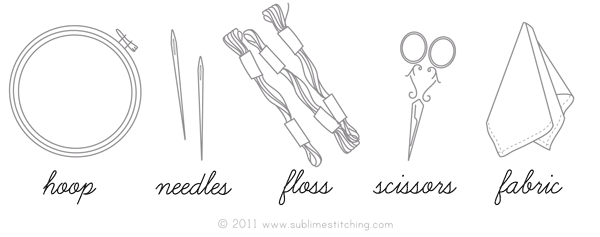
Needle and Floss
</p>
<p align="center">
Iron
</p>
<p align="center">
<a href="/patterns/all">Embroidery Transfers</a><br />
(or your own design)
</p>
<p align="center">
x - x - x - x - x
</p>
<p align="center">
<b>THE BIG IDEA: </b>
</p>
<div style="text-align: center">
<img src="/files/images/blog/lotus_stitched_2.jpg" height="512" width="384" /> <br />
</div>
<div style="text-align: center">
</div>
<div style="text-align: center">
<b>Did you know that you can use hot-iron transfer patterns on paper?</b> Oh, yes you can! Just watch me.<br />
</div>
<div style="text-align: center">
</div>
<div style="text-align: center">
As I'm sure you already know clever reader, the inside of most books and journals have "endpapers". These are blank sheets of heavier paper at the front and back of the book. <a href="/yogajournal.html">This journal</a> has endpapers just perfect for what I'm gonna do: stamp a pattern on the paper and embroider it! The results of this project are based on using the Lotus Journal,
which has really nice, recycled "tree-free" paper (made from
recycled cotton rags). So, be aware that if you use a different journal, your results may be a wee bit different, but that shouldn't stop you from trying. Let's get on with it...
</div>
<div style="text-align: center">
</div>
<div style="text-align: center">
</div>
<p>
</p>
<p align="center">
<img src="/files/images/blog/lotus_stitched_3.jpg" height="384" width="512" />
</p>
<p align="center">
<b>Step One: Transfer the Pattern</b><br />
This might seem just plain weird to do: ironing on paper. But if you're careful, it will turn out just like when transferring to fabric. You will pre-heat the paper just as you would your fabric. Lay the pattern, ink-side down, and then press and pass your iron over it. Check for darkness, and repeat if necessary.
</p>
<p align="center">
<i>CAREFUL WHEN IRONING ON PAPER! </i><br />
The hotter the iron, the more easily the ink will transfer, but if it's
too hot, you may curl or even scorch the paper. Try to find that happy medium... It will probably curl a little bit no matter what, which is easily fixed: close the book, weight it down and let it cool. You also want to make doubly sure that the steam setting is OFF. Also, remember that we are working on heavier card-like paper. Not office printer paper. The thinner the paper, the trickier it is to get good results (and harder to stitch on).
</p>
<p align="center">
</p>
<div align="center">
</div>
<p align="center">
<img src="/files/images/blog/lotus_stitched_4.jpg" height="384" width="512" />
</p>
<p align="center">
<b>Houston: We have pattern transfer. (Roger that.)</b><br />
Lookit that! It's like magic! You can use any transfer pattern your little heart desires, <br />
but this one I used is from my <a href="/sublimestitch_book" target="_blank">Sublime Stitching book</a>.
</p>
<p align="center">
</p>
<div align="center">
</div>
<p align="center">
<img src="/files/images/blog/lotus_stitched_5.jpg" height="512" width="384" />
</p>
<p align="center">
<b>Step Two: Start Pokin'</b><br />
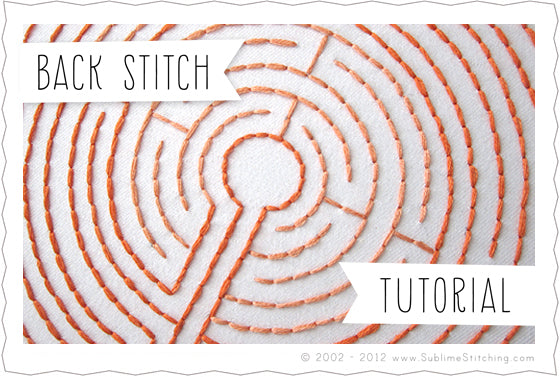
With an unthreaded needle, pass it completely from front to back (not back-to-front) to pre-poke your holes. Why front-to-back? Because it will create a little raised bur on the backside (see next photo). I chose this design because the places where holes will go are already pretty easy to determine: at each endpoint and wherever the lines meet. If you are working with another design, I suggest making your holes about 1/4" apart and working in the simple, but charming <a href="/stitches#Back%20Stitch">back stitch</a>.
</p>
<p align="center">
</p>
<p align="center">
<img src="/files/images/blog/lotus_stitched_back.jpg" height="512" width="384" />
</p>
<p align="center">
<b>SHOW ME YOUR...</b><br />
I know you want to see the back. Here it is! Those 'burs' I mentioned earlier.
</p>
<p align="center">
</p>
<div align="center">
</div>
<p align="center">
<img src="/files/images/blog/lotus_stitched_6.jpg" height="384" width="512" />
</p>
<p align="center">
<b>Step Three: Stitch It Up </b>
</p>
<p align="center">
I used all six-strands of cotton floss. Remember to start from behind your work, and this is a time when you might want to skip the knots and instead weave your tail along the backside of your stitches. If you know how to work a <a href="/stitches#Back%20Stitch">back stitch</a>, you know how to do this.
</p>
<p align="center">
<b>PRIZE-WINNING QUESTION:</b><br />
Do you know what stitch this is? Answer in comments below- first to answer correctly will get my journal!
</p>
<p align="center">
ETA: We have a winner, and her name is sewadorable.
</p>
<br />
<div align="center">
</div>
<p align="center">
<img src="/files/images/blog/lotus_stitched_8.jpg" height="512" width="384" />
</p>
<p align="center">
Lovely! Now when you open up the cover, there is even more stitching inside to greet you. And, you certainly don't have to stop there...
</p>
<p align="center">
You could even keep stitching on the pages inside, or continue using the transfers as templates for painting and embellishing in other ways. Have fun! <a href="/jennyhartbio.html"><b>~Jenny</b></a>
</p>
<p align="center">
</p>
<p align="center">
<b> You Might Also Dig:</b><a href="/yogajournal.html"><br />
</a>
</p>
<p align="center">
<a href="/sublime+stitching+journal.html">Sublime Stitching Journal</a>
</p>
<p align="center">
<a href="/stitchablestationery.html">Stitchable Stationery </a>
</p>
<p align="center">
<a href="/floss_pastel_mini.html">These floss colors</a>
</p>
<p align="center">
<a href="/patterns/all">Transfer Patterns</a>
</p>
<p align="center">
<a href="/howto.html">More projects! </a>
</p>
<h3 align="center"><br />
</h3>
]
[teaser] => [ <h3>
PROJECT: EMBROIDERED END-PAPERS</h3>
<div style="text-align: center">
<img src="/files/images/blog/lotus_stitched_1.jpg" height="512" width="384" />
</div>
<p>
</p>
<p align="center">
You know that my <a href="/yogajournal.html">Embroidered Lotus Journal</a> is already stitched on the outside, but did you know you can stitch it on the inside too? Oh yes, you can! Ima show you how. Get ready to learn a whole new use for <a href="/patterns/all">the transfers</a>!
</p>
<p align="center">
<b>~WIN THIS PROJECT~</b><br />
If you can answer the question in Step Three, you win this journal I stitched up as the example!
</p>
<p align="center">
x - x - x - x - x
</p>
<p align="center">
<b>What:</b> <b>Lotus Journal Embroidered Endpapers</b>
</p>
<p align="center">
<b>Who: </b>You!<b><br />
</b>
</p>
<div align="center">
</div>
<p align="center">
<b>When:</b> Right now! Or, when you have time. Give yourself 1-2 hours
</p>
<p align="center">
<b>Easiness Level:</b> Beginner to Intermediate
</p>
<p align="center">
<b>You'll Need:</b>
</p>
<p align="center">
<a href="/yogajournal.html">Sublime Stitching Lotus Journal</a><br />
(or a journal with heavy, blank end-papers)
</p>
<p align="center">
Needle and Floss
</p>
<p align="center">
Iron
</p>
<p align="center">
<a href="/patterns/all">Embroidery Transfers</a><br />
(or your own design)
</p>
<p align="center">
x - x - x - x - x
</p>
<p align="center">
<b>THE BIG IDEA: </b>
</p>
<div style="text-align: center">
<img src="/files/images/blog/lotus_stitched_2.jpg" height="512" width="384" /> <br />
</div>
<div style="text-align: center">
</div>
<div style="text-align: center">
<b>Did you know that you can use hot-iron transfer patterns on paper?</b> Oh, yes you can! Just watch me.<br />
</div>
<div style="text-align: center">
</div>
<div style="text-align: center">
As I'm sure you already know clever reader, the inside of most books and journals have "endpapers". These are blank sheets of heavier paper at the front and back of the book. <a href="/yogajournal.html">This journal</a> has endpapers just perfect for what I'm gonna do: stamp a pattern on the paper and embroider it! The results of this project are based on using the Lotus Journal,
which has really nice, recycled "tree-free" paper (made from
recycled cotton rags). So, be aware that if you use a different journal, your results may be a wee bit different, but that shouldn't stop you from trying. Let's get on with it...
</div>
<div style="text-align: center">
</div>
<div style="text-align: center">
</div>
<p>
</p>
<p align="center">
<img src="/files/images/blog/lotus_stitched_3.jpg" height="384" width="512" />
</p>
<p align="center">
<b>Step One: Transfer the Pattern</b><br />
This might seem just plain weird to do: ironing on paper. But if you're careful, it will turn out just like when transferring to fabric. You will pre-heat the paper just as you would your fabric. Lay the pattern, ink-side down, and then press and pass your iron over it. Check for darkness, and repeat if necessary.
</p>
<p align="center">
<i>CAREFUL WHEN IRONING ON PAPER! </i><br />
The hotter the iron, the more easily the ink will transfer, but if it's
too hot, you may curl or even scorch the paper. Try to find that happy medium... It will probably curl a little bit no matter what, which is easily fixed: close the book, weight it down and let it cool. You also want to make doubly sure that the steam setting is OFF. Also, remember that we are working on heavier card-like paper. Not office printer paper. The thinner the paper, the trickier it is to get good results (and harder to stitch on).
</p>
<p align="center">
</p>
<div align="center">
</div>
<p align="center">
<img src="/files/images/blog/lotus_stitched_4.jpg" height="384" width="512" />
</p>
<p align="center">
<b>Houston: We have pattern transfer. (Roger that.)</b><br />
Lookit that! It's like magic! You can use any transfer pattern your little heart desires, <br />
but this one I used is from my <a href="/sublimestitch_book" target="_blank">Sublime Stitching book</a>.
</p>
<p align="center">
</p>
<div align="center">
</div>
<p align="center">
<img src="/files/images/blog/lotus_stitched_5.jpg" height="512" width="384" />
</p>
<p align="center">
<b>Step Two: Start Pokin'</b><br />
With an unthreaded needle, pass it completely from front to back (not back-to-front) to pre-poke your holes. Why front-to-back? Because it will create a little raised bur on the backside (see next photo). I chose this design because the places where holes will go are already pretty easy to determine: at each endpoint and wherever the lines meet. If you are working with another design, I suggest making your holes about 1/4" apart and working in the simple, but charming <a href="/stitches#Back%20Stitch">back stitch</a>.
</p>
<p align="center">
</p>
<p align="center">
<img src="/files/images/blog/lotus_stitched_back.jpg" height="512" width="384" />
</p>
<p align="center">
<b>SHOW ME YOUR...</b><br />
I know you want to see the back. Here it is! Those 'burs' I mentioned earlier.
</p>
<p align="center">
</p>
<div align="center">
</div>
<p align="center">
<img src="/files/images/blog/lotus_stitched_6.jpg" height="384" width="512" />
</p>
<p align="center">
<b>Step Three: Stitch It Up </b>
</p>
<p align="center">
I used all six-strands of cotton floss. Remember to start from behind your work, and this is a time when you might want to skip the knots and instead weave your tail along the backside of your stitches. If you know how to work a <a href="/stitches#Back%20Stitch">back stitch</a>, you know how to do this.
</p>
<p align="center">
<b>PRIZE-WINNING QUESTION:</b><br />
Do you know what stitch this is? Answer in comments below- first to answer correctly will get my journal!
</p>
<p align="center">
ETA: We have a winner, and her name is sewadorable.
</p>
<br />
<div align="center">
</div>
<p align="center">
<img src="/files/images/blog/lotus_stitched_8.jpg" height="512" width="384" />
</p>
<p align="center">
Lovely! Now when you open up the cover, there is even more stitching inside to greet you. And, you certainly don't have to stop there...
</p>
<p align="center">
You could even keep stitching on the pages inside, or continue using the transfers as templates for painting and embellishing in other ways. Have fun! <a href="/jennyhartbio.html"><b>~Jenny</b></a>
</p>
<p align="center">
</p>
<p align="center">
<b> You Might Also Dig:</b><a href="/yogajournal.html"><br />
</a>
</p>
<p align="center">
<a href="/sublime+stitching+journal.html">Sublime Stitching Journal</a>
</p>
<p align="center">
<a href="/stitchablestationery.html">Stitchable Stationery </a>
</p>
<p align="center">
<a href="/floss_pastel_mini.html">These floss colors</a>
</p>
<p align="center">
<a href="/patterns/all">Transfer Patterns</a>
</p>
<p align="center">
<a href="/howto.html">More projects! </a>
</p>
<h3 align="center"><br />
</h3>
]
[log] => []
[format] => [4]
[uid] => [2]
[name] => [Jenny ♥]
[picture] => []
[data] => [a:2:{s:7:"contact";i:1;s:29:"taxonomy_image_disable_images";i:0;}]
[search_block] => []
[nodewords] => []
[last_comment_timestamp] => [1259273726]
[last_comment_name] => []
[comment_count] => [16]
[taxonomy] => []
[files] => []
[readmore] => []
[content] => array (
[body] => array (
[#weight] => [0]
[#value] => [ <h3>
PROJECT: EMBROIDERED END-PAPERS</h3>
<div style="text-align: center">
<img src="/files/images/blog/lotus_stitched_1.jpg" height="512" width="384" />
</div>
<p>
</p>
<p align="center">
You know that my <a href="/yogajournal.html">Embroidered Lotus Journal</a> is already stitched on the outside, but did you know you can stitch it on the inside too? Oh yes, you can! Ima show you how. Get ready to learn a whole new use for <a href="/patterns/all">the transfers</a>!
</p>
<p align="center">
<b>~WIN THIS PROJECT~</b><br />
If you can answer the question in Step Three, you win this journal I stitched up as the example!
</p>
<p align="center">
x - x - x - x - x
</p>
<p align="center">
<b>What:</b> <b>Lotus Journal Embroidered Endpapers</b>
</p>
<p align="center">
<b>Who: </b>You!<b><br />
</b>
</p>
<div align="center">
</div>
<p align="center">
<b>When:</b> Right now! Or, when you have time. Give yourself 1-2 hours
</p>
<p align="center">
<b>Easiness Level:</b> Beginner to Intermediate
</p>
<p align="center">
<b>You'll Need:</b>
</p>
<p align="center">
<a href="/yogajournal.html">Sublime Stitching Lotus Journal</a><br />
(or a journal with heavy, blank end-papers)
</p>
<p align="center">
Needle and Floss
</p>
<p align="center">
Iron
</p>
<p align="center">
<a href="/patterns/all">Embroidery Transfers</a><br />
(or your own design)
</p>
<p align="center">
x - x - x - x - x
</p>
<p align="center">
<b>THE BIG IDEA: </b>
</p>
<div style="text-align: center">
<img src="/files/images/blog/lotus_stitched_2.jpg" height="512" width="384" /> <br />
</div>
<div style="text-align: center">
</div>
<div style="text-align: center">
<b>Did you know that you can use hot-iron transfer patterns on paper?</b> Oh, yes you can! Just watch me.<br />
</div>
<div style="text-align: center">
</div>
<div style="text-align: center">
As I'm sure you already know clever reader, the inside of most books and journals have "endpapers". These are blank sheets of heavier paper at the front and back of the book. <a href="/yogajournal.html">This journal</a> has endpapers just perfect for what I'm gonna do: stamp a pattern on the paper and embroider it! The results of this project are based on using the Lotus Journal,
which has really nice, recycled "tree-free" paper (made from
recycled cotton rags). So, be aware that if you use a different journal, your results may be a wee bit different, but that shouldn't stop you from trying. Let's get on with it...
</div>
<div style="text-align: center">
</div>
<div style="text-align: center">
</div>
<p>
</p>
<p align="center">
<img src="/files/images/blog/lotus_stitched_3.jpg" height="384" width="512" />
</p>
<p align="center">
<b>Step One: Transfer the Pattern</b><br />
This might seem just plain weird to do: ironing on paper. But if you're careful, it will turn out just like when transferring to fabric. You will pre-heat the paper just as you would your fabric. Lay the pattern, ink-side down, and then press and pass your iron over it. Check for darkness, and repeat if necessary.
</p>
<p align="center">
<i>CAREFUL WHEN IRONING ON PAPER! </i><br />
The hotter the iron, the more easily the ink will transfer, but if it's
too hot, you may curl or even scorch the paper. Try to find that happy medium... It will probably curl a little bit no matter what, which is easily fixed: close the book, weight it down and let it cool. You also want to make doubly sure that the steam setting is OFF. Also, remember that we are working on heavier card-like paper. Not office printer paper. The thinner the paper, the trickier it is to get good results (and harder to stitch on).
</p>
<p align="center">
</p>
<div align="center">
</div>
<p align="center">
<img src="/files/images/blog/lotus_stitched_4.jpg" height="384" width="512" />
</p>
<p align="center">
<b>Houston: We have pattern transfer. (Roger that.)</b><br />
Lookit that! It's like magic! You can use any transfer pattern your little heart desires, <br />
but this one I used is from my <a href="/sublimestitch_book" target="_blank">Sublime Stitching book</a>.
</p>
<p align="center">
</p>
<div align="center">
</div>
<p align="center">
<img src="/files/images/blog/lotus_stitched_5.jpg" height="512" width="384" />
</p>
<p align="center">
<b>Step Two: Start Pokin'</b><br />
With an unthreaded needle, pass it completely from front to back (not back-to-front) to pre-poke your holes. Why front-to-back? Because it will create a little raised bur on the backside (see next photo). I chose this design because the places where holes will go are already pretty easy to determine: at each endpoint and wherever the lines meet. If you are working with another design, I suggest making your holes about 1/4" apart and working in the simple, but charming <a href="/stitches#Back%20Stitch">back stitch</a>.
</p>
<p align="center">
</p>
<p align="center">
<img src="/files/images/blog/lotus_stitched_back.jpg" height="512" width="384" />
</p>
<p align="center">
<b>SHOW ME YOUR...</b><br />
I know you want to see the back. Here it is! Those 'burs' I mentioned earlier.
</p>
<p align="center">
</p>
<div align="center">
</div>
<p align="center">
<img src="/files/images/blog/lotus_stitched_6.jpg" height="384" width="512" />
</p>
<p align="center">
<b>Step Three: Stitch It Up </b>
</p>
<p align="center">
I used all six-strands of cotton floss. Remember to start from behind your work, and this is a time when you might want to skip the knots and instead weave your tail along the backside of your stitches. If you know how to work a <a href="/stitches#Back%20Stitch">back stitch</a>, you know how to do this.
</p>
<p align="center">
<b>PRIZE-WINNING QUESTION:</b><br />
Do you know what stitch this is? Answer in comments below- first to answer correctly will get my journal!
</p>
<p align="center">
ETA: We have a winner, and her name is sewadorable.
</p>
<br />
<div align="center">
</div>
<p align="center">
<img src="/files/images/blog/lotus_stitched_8.jpg" height="512" width="384" />
</p>
<p align="center">
Lovely! Now when you open up the cover, there is even more stitching inside to greet you. And, you certainly don't have to stop there...
</p>
<p align="center">
You could even keep stitching on the pages inside, or continue using the transfers as templates for painting and embellishing in other ways. Have fun! <a href="/jennyhartbio.html"><b>~Jenny</b></a>
</p>
<p align="center">
</p>
<p align="center">
<b> You Might Also Dig:</b><a href="/yogajournal.html"><br />
</a>
</p>
<p align="center">
<a href="/sublime+stitching+journal.html">Sublime Stitching Journal</a>
</p>
<p align="center">
<a href="/stitchablestationery.html">Stitchable Stationery </a>
</p>
<p align="center">
<a href="/floss_pastel_mini.html">These floss colors</a>
</p>
<p align="center">
<a href="/patterns/all">Transfer Patterns</a>
</p>
<p align="center">
<a href="/howto.html">More projects! </a>
</p>
<h3 align="center"><br />
</h3>
]
[#printed] => [1]
)
[#children] => [ <h3>
PROJECT: EMBROIDERED END-PAPERS</h3>
<div style="text-align: center">
<img src="/files/images/blog/lotus_stitched_1.jpg" height="512" width="384" />
</div>
<p>
</p>
<p align="center">
You know that my <a href="/yogajournal.html">Embroidered Lotus Journal</a> is already stitched on the outside, but did you know you can stitch it on the inside too? Oh yes, you can! Ima show you how. Get ready to learn a whole new use for <a href="/patterns/all">the transfers</a>!
</p>
<p align="center">
<b>~WIN THIS PROJECT~</b><br />
If you can answer the question in Step Three, you win this journal I stitched up as the example!
</p>
<p align="center">
x - x - x - x - x
</p>
<p align="center">
<b>What:</b> <b>Lotus Journal Embroidered Endpapers</b>
</p>
<p align="center">
<b>Who: </b>You!<b><br />
</b>
</p>
<div align="center">
</div>
<p align="center">
<b>When:</b> Right now! Or, when you have time. Give yourself 1-2 hours
</p>
<p align="center">
<b>Easiness Level:</b> Beginner to Intermediate
</p>
<p align="center">
<b>You'll Need:</b>
</p>
<p align="center">
<a href="/yogajournal.html">Sublime Stitching Lotus Journal</a><br />
(or a journal with heavy, blank end-papers)
</p>
<p align="center">
Needle and Floss
</p>
<p align="center">
Iron
</p>
<p align="center">
<a href="/patterns/all">Embroidery Transfers</a><br />
(or your own design)
</p>
<p align="center">
x - x - x - x - x
</p>
<p align="center">
<b>THE BIG IDEA: </b>
</p>
<div style="text-align: center">
<img src="/files/images/blog/lotus_stitched_2.jpg" height="512" width="384" /> <br />
</div>
<div style="text-align: center">
</div>
<div style="text-align: center">
<b>Did you know that you can use hot-iron transfer patterns on paper?</b> Oh, yes you can! Just watch me.<br />
</div>
<div style="text-align: center">
</div>
<div style="text-align: center">
As I'm sure you already know clever reader, the inside of most books and journals have "endpapers". These are blank sheets of heavier paper at the front and back of the book. <a href="/yogajournal.html">This journal</a> has endpapers just perfect for what I'm gonna do: stamp a pattern on the paper and embroider it! The results of this project are based on using the Lotus Journal,
which has really nice, recycled "tree-free" paper (made from
recycled cotton rags). So, be aware that if you use a different journal, your results may be a wee bit different, but that shouldn't stop you from trying. Let's get on with it...
</div>
<div style="text-align: center">
</div>
<div style="text-align: center">
</div>
<p>
</p>
<p align="center">
<img src="/files/images/blog/lotus_stitched_3.jpg" height="384" width="512" />
</p>
<p align="center">
<b>Step One: Transfer the Pattern</b><br />
This might seem just plain weird to do: ironing on paper. But if you're careful, it will turn out just like when transferring to fabric. You will pre-heat the paper just as you would your fabric. Lay the pattern, ink-side down, and then press and pass your iron over it. Check for darkness, and repeat if necessary.
</p>
<p align="center">
<i>CAREFUL WHEN IRONING ON PAPER! </i><br />
The hotter the iron, the more easily the ink will transfer, but if it's
too hot, you may curl or even scorch the paper. Try to find that happy medium... It will probably curl a little bit no matter what, which is easily fixed: close the book, weight it down and let it cool. You also want to make doubly sure that the steam setting is OFF. Also, remember that we are working on heavier card-like paper. Not office printer paper. The thinner the paper, the trickier it is to get good results (and harder to stitch on).
</p>
<p align="center">
</p>
<div align="center">
</div>
<p align="center">
<img src="/files/images/blog/lotus_stitched_4.jpg" height="384" width="512" />
</p>
<p align="center">
<b>Houston: We have pattern transfer. (Roger that.)</b><br />
Lookit that! It's like magic! You can use any transfer pattern your little heart desires, <br />
but this one I used is from my <a href="/sublimestitch_book" target="_blank">Sublime Stitching book</a>.
</p>
<p align="center">
</p>
<div align="center">
</div>
<p align="center">
<img src="/files/images/blog/lotus_stitched_5.jpg" height="512" width="384" />
</p>
<p align="center">
<b>Step Two: Start Pokin'</b><br />
With an unthreaded needle, pass it completely from front to back (not back-to-front) to pre-poke your holes. Why front-to-back? Because it will create a little raised bur on the backside (see next photo). I chose this design because the places where holes will go are already pretty easy to determine: at each endpoint and wherever the lines meet. If you are working with another design, I suggest making your holes about 1/4" apart and working in the simple, but charming <a href="/stitches#Back%20Stitch">back stitch</a>.
</p>
<p align="center">
</p>
<p align="center">
<img src="/files/images/blog/lotus_stitched_back.jpg" height="512" width="384" />
</p>
<p align="center">
<b>SHOW ME YOUR...</b><br />
I know you want to see the back. Here it is! Those 'burs' I mentioned earlier.
</p>
<p align="center">
</p>
<div align="center">
</div>
<p align="center">
<img src="/files/images/blog/lotus_stitched_6.jpg" height="384" width="512" />
</p>
<p align="center">
<b>Step Three: Stitch It Up </b>
</p>
<p align="center">
I used all six-strands of cotton floss. Remember to start from behind your work, and this is a time when you might want to skip the knots and instead weave your tail along the backside of your stitches. If you know how to work a <a href="/stitches#Back%20Stitch">back stitch</a>, you know how to do this.
</p>
<p align="center">
<b>PRIZE-WINNING QUESTION:</b><br />
Do you know what stitch this is? Answer in comments below- first to answer correctly will get my journal!
</p>
<p align="center">
ETA: We have a winner, and her name is sewadorable.
</p>
<br />
<div align="center">
</div>
<p align="center">
<img src="/files/images/blog/lotus_stitched_8.jpg" height="512" width="384" />
</p>
<p align="center">
Lovely! Now when you open up the cover, there is even more stitching inside to greet you. And, you certainly don't have to stop there...
</p>
<p align="center">
You could even keep stitching on the pages inside, or continue using the transfers as templates for painting and embellishing in other ways. Have fun! <a href="/jennyhartbio.html"><b>~Jenny</b></a>
</p>
<p align="center">
</p>
<p align="center">
<b> You Might Also Dig:</b><a href="/yogajournal.html"><br />
</a>
</p>
<p align="center">
<a href="/sublime+stitching+journal.html">Sublime Stitching Journal</a>
</p>
<p align="center">
<a href="/stitchablestationery.html">Stitchable Stationery </a>
</p>
<p align="center">
<a href="/floss_pastel_mini.html">These floss colors</a>
</p>
<p align="center">
<a href="/patterns/all">Transfer Patterns</a>
</p>
<p align="center">
<a href="/howto.html">More projects! </a>
</p>
<h3 align="center"><br />
</h3>
]
[#printed] => [1]
)
);
Nice work. You just gave me
Nice work. You just gave me a brilliant idea on how to spend weekend with my 6 year old daughter. She could use a little creativity boost and I think she would enjoy doing this. Where can I get all the supplies? I would rather have a binder system for the paper, few cheap binders will do, what's more important is the creative process.
Wheat Stitch
Is the name of the image you just stitched. It looks like wheat to me.
lotus journal question
I think it is a backstitch.
answer
Back Stich! Yay! Right?
Fern Stitch Possibly?
Is that the Fern Stitch???
Thanks for the tute!
Kandra (@ siblingcraftery.com)
WINNER: sewadorable "Fernstitch"
DINGDINGDING! I commend all of you for your enthusiastic guessing! "Flystitch" was a very good guess. Sewadorable is the winner! And, for all of you who have commented until now, you will get a 10% voucher code!
And, next time, just to be fair- I'll stipulate one guess per person. :X
THANKS
OH I a so super excited..THANKS!
Is it the wheat
Is it the wheat stitch?
Whatever it is, it is darling.
Fern Stitch
Okay this is my last comment I promise..But I think it is now a fern stitch. As you can tell I would really love to when this journal.
Back Stitch
Is it a back stitch?
is it a wheat stitch?
back stitch
back stitch
stitch guess
looks like a modified fly stitch to my beginner eye.
Close...
...but no cigar -yet!
Wheat Stitch
Is the name of the design you just stitched. It looks like wheat to me.
Drat!
Didn't respond in time...